
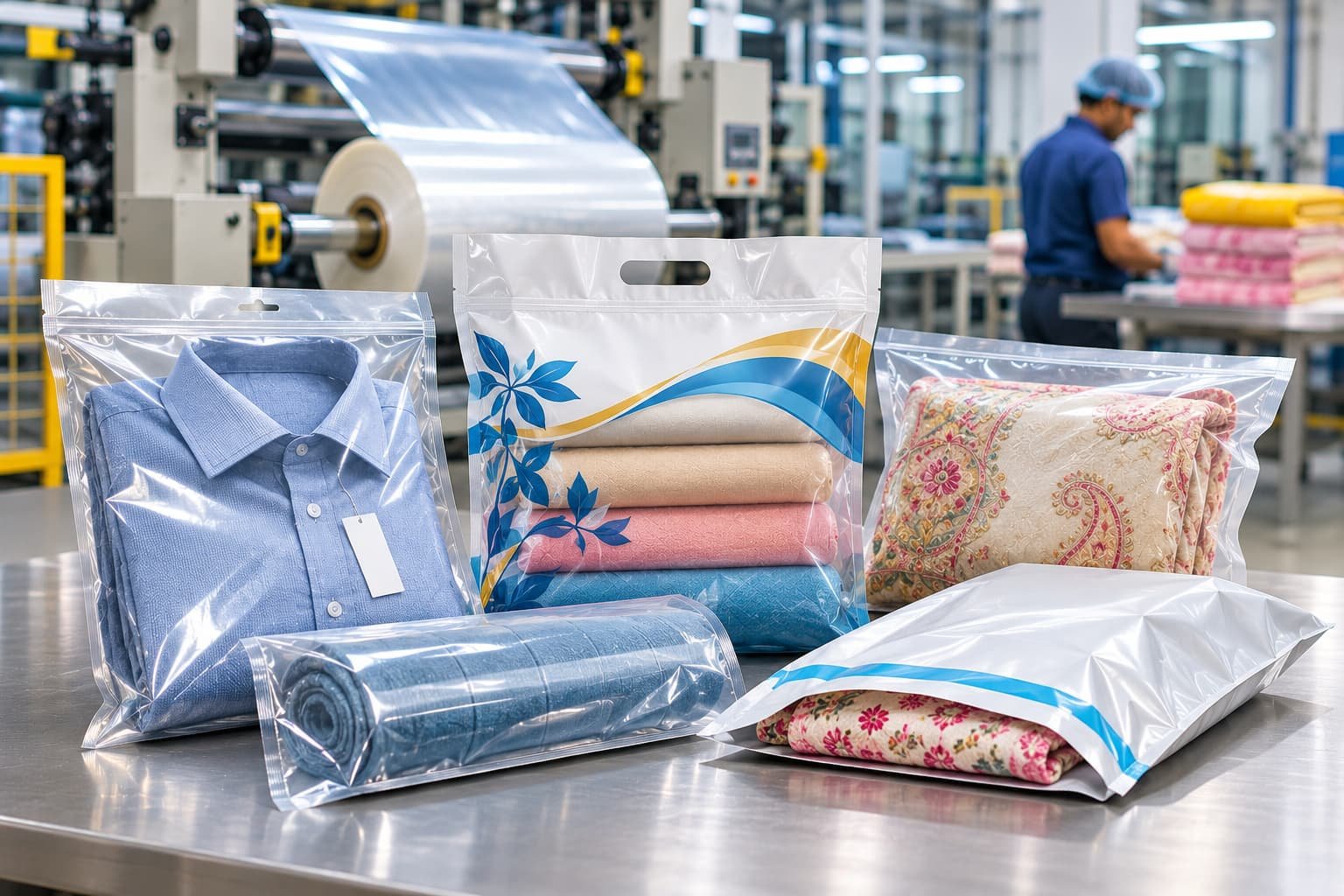
A textile product can lose its commercial value if it arrives at its destination with damaged packaging, unwanted moisture exposure or poor presentation. For textile manufacturers and exporters, textile packaging solutions must support the product throughout storage, transportation and distribution.
A suitable packaging material should match the fabric, packaging format and intended handling conditions. From garment manufacturers to businesses shipping fabric rolls, selecting the right packaging requires a clear understanding of the product and its journey.
Why textile products need suitable packaging
Textile products vary widely in their physical characteristics. A folded garment, a roll of fabric and a large textile bale have different packaging requirements. The packaging must account for the product’s size, weight, surface characteristics and sensitivity to environmental conditions.
For example, a garment intended for retail sale may require clear printed packaging that supports product presentation. A fabric roll moving between manufacturing facilities may require packaging designed around handling and transportation. The correct solution depends on the textile product and its intended use.
Common textile packaging requirements
Protection during handling
Textile packaging may experience movement, stacking and handling during transportation. The packaging material should be suitable for these conditions and help reduce the risk of damage to the packaged product. Buyers should evaluate the required strength and dimensions based on the product’s weight and packaging format.
Moisture management
Humidity and moisture exposure can affect certain textile products during storage and transportation. Packaging selection should consider the expected storage environment and the sensitivity of the textile material.
However, packaging film alone does not guarantee protection against every moisture-related risk. Buyers should assess the complete storage and handling conditions.
Dust and surface protection
Textile products may require protection from dust and external contaminants. A suitable packaging format can help reduce exposure during storage and distribution. The required protection depends on whether the product is a finished garment, a fabric roll or an industrial textile.
Product presentation
Packaging also contributes to how a textile product is presented. Printed films and suitable packaging finishes can help communicate branding and product information. For retail products, buyers may also consider whether the packaging should allow the customer to see the fabric.
Textile packaging applications
Garment packaging
Finished garments may require packaging that protects the product while supporting retail presentation. Packaging dimensions should accommodate the garment without unnecessary compression. The design should also consider product identification, branding and the intended distribution channel.
Fabric roll packaging
Fabric rolls require packaging that accommodates their length, diameter and handling requirements. The material should be suitable for the roll’s dimensions and the conditions it will experience during storage and transportation. A packaging trial can help determine whether the selected material and format provide the required performance.
Home textile packaging
Products such as towels, bedding and other home textiles may require packaging that supports product presentation and distribution. The packaging format should account for the product’s dimensions, folding method and intended retail or wholesale channel.
Textile export packaging
Textile exports may pass through multiple handling and transportation stages. Businesses should evaluate packaging requirements based on the product, destination, storage environment and transportation arrangements. The packaging should also carry the information required for the relevant commercial and distribution process.
Choosing the right textile packaging film
The choice of film should begin with the product’s requirements. Different film materials have different characteristics, and the correct selection depends on the packaging application.
Kanodia Technoplast’s textile packaging article identifies PE, PP and PET among the materials discussed for textile packaging applications. It also describes customisation according to packaging dimensions and printing requirements. Buyers should evaluate the following factors before choosing a film.
| Selection factor | What to consider |
| Material | Suitability for the textile product and intended packaging format |
| Thickness | Required strength and handling performance |
| Dimensions | Product size, folding method or roll dimensions |
| Printing | Branding, product information and artwork |
| Storage | Expected environmental conditions |
| Distribution | Handling, transportation and stacking requirements |
The supplier should provide relevant technical information to support the selection.
How packaging customisation helps textile businesses
Textile manufacturers may package several products with different dimensions and distribution requirements. Customisation allows packaging specifications to reflect these differences.
For example, a garment manufacturer may require different packaging dimensions for different product sizes. A fabric supplier may need a packaging format that accommodates specific roll dimensions. Customisation can also address artwork, colour and printing requirements.
The important point is to establish the product specification before finalising the packaging design.
What should textile manufacturers ask a packaging supplier?
Material suitability
Ask which packaging materials are available and how they match the intended application. The supplier should explain the relevant material characteristics and provide supporting information.
Quality consistency
Discuss how the manufacturer monitors film dimensions, printing quality and other relevant specifications. For businesses using packaging in regular production, consistency between orders is important.
Customisation capabilities
Confirm whether the supplier can support the required dimensions, thickness, print design and packaging format. Do not assume that every customisation option is available for every material.
Production and supply planning
Packaging buyers should discuss their expected order quantities and delivery schedules. These requirements help determine whether the supplier’s available manufacturing capabilities are suitable for the business.
How Kanodia Technoplast supports textile packaging requirements
Kanodia Technoplast offers packaging films and flexible packaging products for different industries. Its website describes textile packaging applications involving packaging films and customisation. The company also lists CPP, metallised and other specialised films within its broader packaging films range.
For textile businesses, the appropriate next step is to identify the required packaging format and discuss material suitability, dimensions, printing and expected performance. The company should confirm which specific materials and customisation options are available for the intended application.
Conclusion
Textile packaging solutions must address product protection, presentation, handling and distribution requirements. The right packaging format for a finished garment may differ from the one needed for a fabric roll or an industrial textile.
Businesses should establish their product specifications, evaluate suitable materials and confirm supplier capabilities before approving packaging for regular production.
CTA: Explore Kanodia Technoplast’s packaging films at https://kanodiaindia.com/packaging-films/ and textile packaging information at https://kanodiaindia.com/blog/choosing-the-right-textile-packaging-films-solutions-in-india/.
Reference Link Table
| Relevant resource | Why it is relevant | Link |
| Packaging Films | Provides an overview of packaging film categories | https://kanodiaindia.com/packaging-films/ |
| Textile Packaging Films | Discusses textile packaging materials and customisation | https://kanodiaindia.com/blog/choosing-the-right-textile-packaging-films-solutions-in-india/ |
| Textile Packaging Solutions | Supporting information about textile packaging applications | https://kanodiaindia.com/blog/textile-packaging-films-solutions-ensuring-durability-and-aesthetic-appeal/ |
FAQs
What are textile packaging solutions?
Textile packaging solutions include films and packaging formats designed to protect and present fabrics, garments and other textile products.
Which materials are used in textile packaging?
PE, PP, PET and suitable laminated films are used in different applications. The correct material depends on the product and packaging requirements.
Why is packaging important for textile exports?
Suitable packaging helps manage handling, storage and transportation risks while supporting product presentation and identification.
Can textile packaging be customised?
Yes. Packaging can be customised according to product dimensions, material requirements, printing and the intended packaging format.
How do I choose textile packaging films?
Evaluate material suitability, thickness, dimensions, printing requirements, storage conditions and expected handling.
Does Kanodia Technoplast offer textile packaging solutions?
Kanodia Technoplast discusses textile packaging films and customisation on its website. Contact the company to confirm the specific products available.


