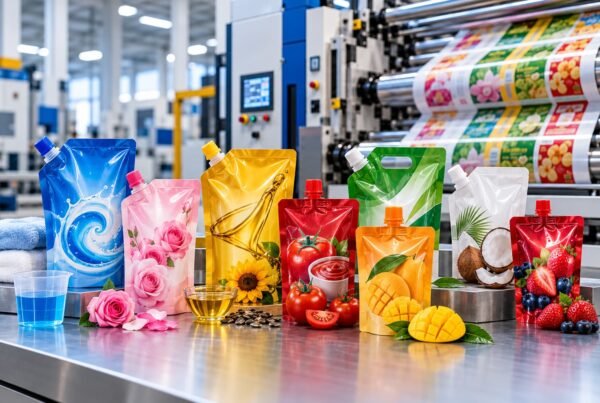

Open a snack pack and you are probably holding both films at once. The glossy printed outer layer is often BOPP, and the inner layer that seals the pack may be CPP. Many buyers who search for a BOPP CPP film manufacturer India are really trying to understand how these two films work together, and which supplier can deliver the right grade for a particular pack.
This article explains how each film is made, how they differ in stiffness, optics, sealing and printing, and how to choose a manufacturer without assuming that either material is better in every case.
Two Films, Two Manufacturing Routes
Both films start as polypropylene, but they are shaped differently.
BOPP stands for biaxially oriented polypropylene. The melt is extruded as a sheet, cooled, then stretched in the machine direction and again in the transverse direction, usually on a tenter frame. Stretching aligns the polymer chains. As manufacturers’ technical descriptions explain, such as this overview from EuroPlas, the result is a film with strong mechanical properties and good clarity. The source is a resin supplier, so read it as an industry explanation and not as independent testing.
CPP stands for cast polypropylene. The melt passes through a flat die onto a chilled roll and solidifies without the two-way stretching step. Without orientation, CPP is generally softer and more flexible, and it seals at lower temperatures than a typical BOPP film.
BOPP and CPP Packaging Films Compared
The table below gives general tendencies. Real behaviour changes with grade, thickness and structure, so use it to frame questions, not to settle them.
| Property | BOPP (general tendency) | CPP (general tendency) |
| Stiffness | Higher, holds shape on machines | Lower, softer feel |
| Flexibility | Moderate | Higher |
| Clarity and gloss | Usually strong, often chosen for printed faces | Good, depends on grade and processing |
| Heat sealing | Depends on the sealable skin layer | Typically a key strength |
| Printing | Common as the printed web after treatment | Printable after treatment, often used inside |
| Typical role | Outer web, print carrier, metallising base | Sealant layer, metallising base, standalone film |
Stiffness, Flexibility and Converting Behaviour
Stiffness affects how a film travels through a printing press, laminator or packing machine. A stiffer film tends to track steadily, while a softer film can stretch or wrinkle if tension is poorly controlled. That is why very thin CPP can be harder to handle, and why converters often discuss tension settings with the supplier before trials begin.
Flexibility has benefits too. A softer film can conform to a seal area and may tolerate crumpling better in some pack types. The right balance depends on your machine, speed and pack format.
Optical Properties and Printing
Both films can offer high clarity and gloss, but the actual result depends on grade and process. For a printed pack, buyers usually specify treatment level, gloss, haze and the way the film behaves under ink and solvent. Both materials need surface treatment before gravure or flexographic inks and adhesives will anchor reliably, and treatment can fade over time, so ask about storage guidance.
Metallising adds another variable. Metallised BOPP and metallised CPP both offer enhanced barrier and a reflective appearance, yet they behave differently in lamination and sealing. Ask for sample structures that match your pack, not generic metallised rolls.
Sealing and Lamination
Sealing is where the two films most often divide roles. CPP usually forms the inside layer in a laminate because it seals strongly to itself. BOPP can seal too, but its sealing performance depends on the skin layer applied to it, so buyers specify the sealable grade carefully.
For lamination, check adhesive compatibility, bond strength after ageing, and curl. A laminate such as BOPP with a sealant layer is only as good as the match between its layers. Ask the manufacturer how the films were tested in combination with typical adhesives and inks.
Choosing by End Application
Start with the pack, not the polymer name.
A dry snack that needs print impact and a reliable seal often uses a printed outer web with a sealant layer inside. A confectionery twist wrap has different needs, such as dead-fold and release behaviour, so the discussion centres on stiffness and slip. A pack that needs barrier against light or oxygen may add a metallised layer. A medical or retort pack requires an entirely different set of questions about temperature resistance and documentation.
In each case, the practical question is: “Which structure and grade meet our line speed, barrier, sealing and appearance requirements?” Answering it often means testing two or three structures, not choosing a material by reputation.
Many packs combine both films, so a manufacturer who understands both families can be easier to work with than two suppliers who each see only half of the structure. That does not mean one supplier must make everything. It means the structural discussion should involve people who understand how the layers interact.
Grade and Structure Matter More Than the Polymer Name
The label “BOPP” or “CPP” describes a family, not a performance guarantee. Two BOPP grades can differ in skin layers, additives and treatment. Two CPP grades can differ in layers, slip package and sealing behaviour. Always specify the exact grade, thickness and supply condition, and confirm them in writing.
Do not assume that thinner means weaker or that thicker means better. Downgauging is common, but it requires attention to stiffness, handling and seal integrity.
A Practical Trial Checklist
Before approving a film, run a structured trial. Record the grade, thickness and lot number. Run the film on your actual machine at production speed. Measure seal strength across a temperature range, check print registration and ink adhesion, and test laminate bond strength both fresh and after ageing. Note any curl, wrinkling, static or web wander. Then repeat the trial with a second lot, and share the results with the manufacturer so it can adjust the grade if needed.
How to Evaluate a BOPP CPP Film Manufacturer in India
A manufacturer’s value shows up in several areas. Check quality consistency across lots, the clarity of technical documentation, the willingness to support line trials, and the reliability of supply. Ask which grades are produced regularly, which are made to order, and how deviations are communicated.
Request test conditions, not just headline numbers. A seal strength figure means little without the method, temperature and dwell time behind it. Consistent answers on these points are a strong sign of a disciplined supplier.
What Kanodia India’s Website Supports
Kanodia Technoplast, through its kanodiaindia.com website, describes a 7-layer CPP film plant and lists transparent, metallised and white opaque CPP variants. Its packaging films page also covers vacuum metallised films, blown PE films, holographic films, window metallised films and gift wraps. The metallising page states that its line handles BOPET, BOPP and CPP substrates.
On the BOPP side, the laminated films page lists structures such as BOPP/PE and BOPP/BOPP for food and other applications. The company has also published a guide on evaluating BOPP film suppliers in India. Because the product pages do not list a base BOPP film line, buyers who need BOPP rolls should ask the team directly which grades are available. Treat this as a normal diligence step, in the same way you would request grade lists and data sheets from any other supplier.
Making the Final Choice
Choosing a BOPP CPP film manufacturer India buyers can trust comes down to a simple approach. Define the pack and machine, shortlist two or three structures, request grade-specific data, run trials, and compare consistency across lots. Remember that neither BOPP nor CPP is the right answer everywhere. The right film is the one whose grade and structure fit your application.
If you are comparing BOPP and CPP packaging films for a specific pack, review the Kanodia India product pages above and email info@kanodiaindia.com with your application, structure and machine details.
REFERENCE LINKS
| Relevant page or resource | Why it is relevant | Verified URL |
| EuroPlas: BOPP Film, How It’s Made | External explanation of the BOPP process; written by a resin supplier, so treat as industry background | https://europlas.com.vn/en-US/blog-1/bopp-film-how-its-made-and-why-you-should-care |
| PlasticsToday: Cast PP gaining ground (2008) | Trade coverage of cast PP processing and its comparison with BOPP; dated | https://www.plasticstoday.com/plastics-processing/cast-pp-gaining-ground-lower-initial-investment-offers-processors-advantages |
| Kanodia India: 7-Layer CPP Film Plant | Company-stated CPP variants and properties | https://kanodiaindia.com/packaging-films/7-layer-cpp-film-plant/ |
| Kanodia India: Laminated Films | Lists BOPP-based laminate structures | https://kanodiaindia.com/laminated-films/ |
FREQUENTLY ASKED QUESTIONS
What does biaxially oriented mean in BOPP film?
It means the film is stretched in both the machine and transverse directions during manufacture. This stretching gives BOPP its characteristic stiffness and clarity.
Can BOPP and CPP be used together in one pack?
Yes, they are often combined in laminates, with BOPP as a printed outer layer and CPP as the inner sealant layer. The exact combination depends on the product and machine.
Which film is better for printing?
Both can be printed after surface treatment, and results depend on grade, ink and press settings. BOPP is common as the printed web, while CPP is more often used inside the pack.
Is metallised CPP the same as metallised BOPP?
No, the metal layer is similar in purpose, but the base films differ in stiffness, sealing and handling. Choose by testing the structure on your application.
How do I know which film grade suits my application?
Share your product, machine, line speed, barrier and sealing needs with the manufacturer and request grade-specific data. Confirm the choice with a line trial.
What should I ask a BOPP or CPP film manufacturer before ordering?
Ask for test methods, tolerance data, lot-to-lot consistency evidence, and the grades produced regularly. Also ask about sample support and lead times.
Does Kanodia India offer BOPP and CPP films?
Its website describes a 7-layer CPP film plant, metallising on BOPET, BOPP and CPP, and BOPP-based laminate structures. Ask the team which BOPP grades they can supply for your application.