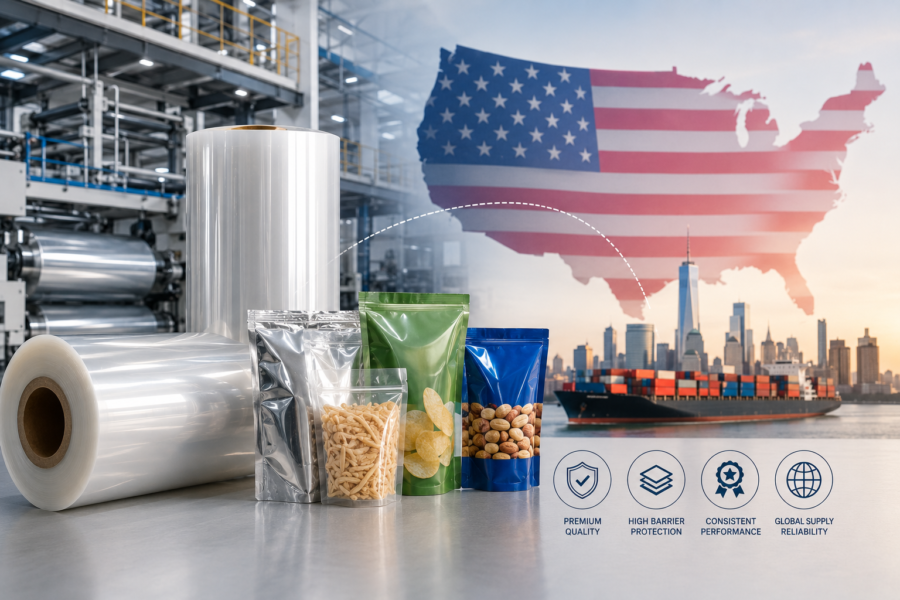

Cast polypropylene film rarely gets the attention BOPP does, yet it is often the layer that decides whether a pack stays closed. CPP is the soft, clear film on the inside of many snack, bakery and confectionery packs, and it is the sealing layer in many laminates. When a seal fails on the line, CPP is usually the first suspect.
Choosing a CPP film manufacturer therefore deserves more than a price comparison. This guide explains how CPP works, which properties matter, how multilayer technology changes performance and what to ask before you place an order. For a shorter market overview, see our earlier article on CPP film manufacturers in India.
Key takeaways
- Seal initiation temperature, hot tack and seal strength should be checked first, on your own machine.
- Layer count helps, but process control and consistency matter just as much.
- Match the variant and grade to the pack: transparent, metallised or white opaque, and general-purpose, retort or pharma.
- Ask any CPP film manufacturer for data on your exact grade, not a family average.
What Is CPP Film?
CPP stands for cast polypropylene. Molten polypropylene is extruded through a flat die and cooled quickly on chilled rolls, which gives a film that is clear, glossy and soft. Unlike BOPP, CPP is not stretched in both directions, so it is less stiff but seals at much lower temperatures.
That is why packaging designers often pair a stiff, printable outer film such as BOPP or polyester with a CPP sealant layer. CPP also resists grease and oil, which suits snack and bakery packs.
Why Seal Performance Is the First Thing to Test
Three seal measures matter most.
Seal initiation temperature (SIT) is the temperature at which the film starts to seal. According to trade press, a typical CPP film seals at roughly 115 to 130 °C, while low-SIT grades start lower. On a horizontal form-fill-seal machine, a lower SIT lets the jaws work faster and can save energy.
Hot tack is the strength of the seal immediately after sealing, before it cools. Products that drop into a pack as it seals need good hot tack.
Seal strength is the force needed to open the sealed joint. It must be strong enough to survive handling and distribution, yet suit the way the pack is opened.
Kanodia Technoplast states that its CPP films offer a seal initiation temperature down to 90 °C and seal strength up to 1 kg, along with excellent hot tack. Treat any such figure as a starting point and confirm it on your own machine and jaw settings.
How 7-Layer Technology Helps
Multilayer coextrusion lets a manufacturer give each layer a job: a sealant skin tuned for low-temperature sealing, a core that carries strength and stiffness, and an outer skin that accepts treatment for inks, adhesives or metallising. More layers give finer control over these roles, although layer count alone does not guarantee a better film. Process control matters just as much.
Kanodia Technoplast runs a 7-layer CPP film plant at its Sonipat, Haryana location, using European extrusion technology. According to the company, the film offers strong ink and adhesive anchoring, good machinability, low static and resistance to grease, oil, tears and punctures.
CPP Variants and Grades: Matching Film to the Pack
The Kanodia CPP range comes in three variants: transparent, metallised and white opaque. Transparent film shows the product or serves as a clear sealant. Metallised film adds a barrier to light, oxygen and moisture and a premium look. White opaque film provides a solid background and blocks light.
Grades matter as well. The company lists general-purpose, retort-grade and pharma-grade CPP. Retort-grade films are designed for pouches that go through heat sterilisation. Pharma-grade films suit sachets and similar packs where cleanliness and consistency come first. Thin gauges such as 15 microns are also reported from the company’s KANCAST PP range, which can reduce material use per pack when the structure allows.
What to Ask a CPP Film Manufacturer
Use this list when you shortlist suppliers.
Seal data. Ask for the SIT, seal curve, hot tack and seal strength for the exact grade you plan to buy.
Gauge and tolerance. Confirm the thickness range and variation across the roll.
Surface treatment. Check the treatment level and how long it lasts, since weak treatment lowers ink and adhesive bonding.
Friction and static. The coefficient of friction and anti-static performance affect how the film runs on laminators and filling machines.
Metallising quality. For metallised CPP, ask about metal adhesion, optical density and scuff resistance.
Application fit. Confirm whether the grade suits adhesive lamination, extrusion lamination, retort or pharma use.
Capacity and continuity. Kanodia Technoplast’s own CPP article cites installed capacity of around 8,000 metric tonnes a year. Ask any manufacturer how much capacity is available for your volumes.
Trials and support. Request trial rolls and technical visits so you can test on your own line.
Here is why grade matters. A snack brand running a high-speed form-fill-seal line will prioritise low SIT and hot tack. A retort pouch converter will prioritise heat resistance and bond strength after sterilisation. Both buy CPP, but they should not buy the same grade.
Common Mistakes When Buying CPP Film
- Comparing films by thickness and price while ignoring seal data
- Approving a grade on a lab sealer without a machine trial
- Using a general-purpose grade where retort or pharma performance is needed
- Overlooking treatment level and storage time before printing or laminating
Sustainability and CPP
Polypropylene films can be designed into all-polypropylene structures, one route to mono-material packs. Thin-gauge CPP can also reduce plastic per pack. The overall result still depends on the full structure, inks, adhesives and local recycling systems, so ask a supplier what a sustainability claim covers and what it does not.
About Kanodia Technoplast
Kanodia Technoplast has worked in flexible packaging since 1995 and describes itself as one of India’s largest CPP film manufacturers. Its CPP film is made at its Sonipat facility for domestic and export customers, alongside vacuum metallised, holographic, window metallised and blown PE films. The wide vacuum metallizer can process CPP as well as BOPET and BOPP.
The group also offers laminated films, pre-formed pouches, spout pouches, inks and adhesives and rotogravure cylinders, so CPP can be supplied as part of a wider packaging programme. You can see the full range on the packaging films page.
Final Takeaway
A CPP film manufacturer earns trust through data, trials and consistency. Check seal performance first, match the variant and grade to the pack, and test on your own line before you commit to volume.
If you are specifying CPP film for a new pack or reviewing your current supplier, contact the Kanodia Technoplast team with your product, machine speed and sealing requirements.
Frequently Asked Questions
What is CPP film?
CPP is cast polypropylene film made by extruding molten polypropylene through a flat die and cooling it on chilled rolls. It is clear, glossy, soft and heat-sealable.
What is CPP film used for?
CPP is mainly used as a sealing layer in laminates and for snack, bakery, confectionery, medical and retort packaging.
What is seal initiation temperature in CPP film?
Seal initiation temperature is the lowest temperature at which the film begins to form a seal. Lower values allow faster sealing and can reduce energy use on packaging machines.
How is CPP different from BOPP?
CPP is soft and seals at low temperatures. BOPP is stiffer, clearer and better suited to printing, so the two are often paired in one laminate.
What is a 7-layer CPP film?
It is a CPP film made on a coextrusion line with seven layers, which allows each layer to be tuned for sealing, strength or surface treatment.
What variants of CPP film are available?
Kanodia Technoplast lists transparent, metallised and white opaque CPP, with general-purpose, retort-grade and pharma-grade options.
How do you choose a CPP film manufacturer?
Ask for seal data for your exact grade, gauge tolerance, surface treatment, friction, metallising quality, capacity and trial support, then test on your own machine.
What should be checked before ordering CPP film?
Confirm the grade for your application, the sealing window against machine speed, gauge, treatment level, roll format, lead time and the documents needed for food or pharma use.